

Joyce Mmereole Okoli
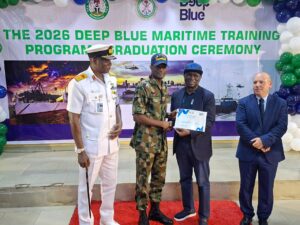
The Nigerian Maritime Administration and Safety Agency (NIMASA) has reaffirmed Nigeria’s rising profile in global maritime security with the graduation of 177 newly trained operatives under the Deep Blue Project’s C4i capability enhancement programme.
Speaking at the graduation ceremony held in Lagos, the Director General/Chief Executive Officer of NIMASA, Dayo Mobereola, said the steady reduction in war-risk insurance premiums for vessels operating in Nigerian waters is a “clear reflection of sustained progress” in the nation’s maritime security environment.
Mobereola stated that Nigeria has now maintained four consecutive years without a single piracy incident, a feat he credited to the country’s integrated maritime security architecture.
“This milestone is not accidental. It is the direct outcome of deliberate investments, strategic partnerships, and the unwavering commitment of our security personnel,” he said.
He added that the enhanced security profile has boosted international confidence, contributing significantly to Nigeria’s re-election into IMO Category Cand lowering the security-related insurance burden for shipowners.
The 177 graduands were trained across key maritime security competencies and include:
• 33 Special Mission Vessel Officers
• 14 Special Mission Vessel Engineers
• 107 Fast Intervention Boat Operators, Technicians and Boarding Teams
• 23 Helicopter Team Officers
Their training covered helicopter operations, medical evacuation, tactical interdictions, drone operations, vessel clearance procedures, and advanced communication and surveillance systems.
Mobereola described the programme as “rigorous, technology-driven, and tailored to modern threats”, adding that the new batch of officers will strengthen Nigeria’s capacity to prevent, detect, and respond to maritime crimes.
The NIMASA DG praised the Minister of Marine and Blue Economy, Adegboyega Oyetola, for providing the policy direction needed to sustain progress in the sector.
“His leadership and clear vision continue to drive the strategic reforms enabling our successes,” Mobereola said.
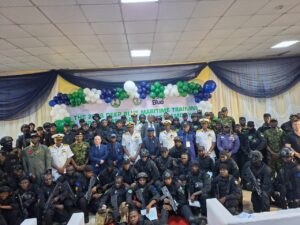
He also acknowledged the role of the Nigerian Armed Forces, Department of State Services, Nigerian Police Force, and international partners such as Homeland Security International, describing them as “pillars of the Deep Blue framework”.
According to him, maintaining maritime security requires “constant collaboration and operational synergy across agencies”.
In his remarks, the Chief of the Naval Staff, Vice Admiral Idi Abbas, represented by the Flag Officer Commanding Western Naval Command, Rear Admiral Abubakar Mustapha, commended the graduands for their exceptional performance during the capability demonstrations.
“Your execution today was surgically precise. It reflects professionalism, confidence, and readiness for deployment,” he said.
Abbas emphasized that the Deep Blue Project is a “classic example of inter-agency collaboration done right”, stressing that modern maritime security demands continuous training, vigilance, and shared responsibility among stakeholders.
He lauded NIMASA’s sustained investments in maritime defense systems, describing the agency as a “strategic partner in strengthening national security and governance across the Gulf of Guinea”.
Mobereola urged the trainees to uphold the highest values of discipline, patriotism, and professionalism as they assume their new roles.
“The nation expects excellence from you. Your work will directly shape Nigeria’s economic stability and global maritime reputation,” he charged.
He added that their deployment will further deepen Nigeria’s resilience against threats and support efforts to build a sustainable and prosperous blue economy.