

Joyce Mmereole Okoli
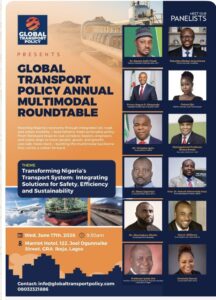
The stage is set for one of the most anticipated transport policy gatherings in the country as the Global Transport Policy (GTP) Annual Multimodal Roundtable Conference holds tomorrow at the prestigious Marriott Hotel, Ikeja, Lagos.
The high-profile event is expected to attract an impressive array of stakeholders, including government officials, policymakers, industry leaders, academics, logistics experts, technology innovators, media practitioners, development partners, and international organisations.
This year’s edition, themed around transforming Nigeria’s transport architecture, promises robust discussions, innovative ideas, and practical solutions aimed at repositioning the nation’s transport sector as a catalyst for economic growth and sustainable development.
Among the international partners expected at the conference are the European Union (EU), African Union (AU), African Development Bank (AfDB), Economic Community of West African States (ECOWAS), and other key development institutions committed to advancing transportation and infrastructure across Africa.
Speaking at a pre-conference press briefing, the Chief Consultant of Global Transport Policy (GTP) and Chief Executive Officer of Widescope Logistics International, Dr. Segun Musa, said the roundtable would confront the critical barriers hindering the effective implementation of a functional multimodal transport system in Nigeria.
According to him, the country continues to grapple with challenges such as weak policy implementation, inadequate political will, and the shortage of competent technocrats needed to drive transportation reforms.
“An effective multimodal transport architecture requires professionals who can identify challenges and implement solutions without unnecessary bureaucracy,” Musa stated.
Reflecting on Nigeria’s transport history, he recalled a period from the 1960s to the mid-1990s when rail transportation played a pivotal role in moving goods seamlessly from the hinterlands to major urban centres, creating efficient supply chains and vibrant commercial activities along transport corridors.
He lamented that the decline of integrated transport systems has contributed significantly to the current challenges facing agriculture, manufacturing, and commodity distribution across the country.
“The inability to move goods efficiently has led to huge losses of perishable products in transit. Farmers and producers are forced to absorb these losses, which ultimately translate into higher prices for consumers,” he said.
Musa noted that transportation costs remain a major driver of inflation and rising commodity prices, stressing that an efficient transport system is fundamental to strengthening Nigeria’s supply chain and improving food security.
“If we can position transport effectively, it will significantly enhance our supply chain and create opportunities for economic growth,” he added.
Speaking on the impact of transportation on agriculture, he argued that many Nigerians are discouraged from farming because of the difficulties associated with moving produce from farms to markets.
“Until we have an effective transport system, it will be difficult to encourage people to return to farming on a large scale. Efficient transportation is central to achieving food security and increasing agricultural productivity,” he said.
Musa further observed that the manufacturing sector is equally affected by the high cost of moving raw materials, machinery, and finished products, making local production less competitive and driving consumers toward imported alternatives.
“We have entrepreneurs willing to invest in manufacturing and production, but without a reliable transport system that supports supply chain distribution, such investments often become unsustainable,” he noted.
He urged policymakers to critically examine the underlying factors fueling inflation and limiting consumers’ purchasing power, emphasizing that transportation remains a key component of the solution.
“Until we get transport right, we won’t get any other thing right,” Musa concluded.