

Joyce Mmereole Okoli
Nigeria’s transport sector is in urgent need of a predictive, integrated, and technology-driven overhaul to unlock economic growth, improve safety, and enhance national competitiveness, the Chartered Institute of Logistics and Transport (CILT) Nigeria has declared.
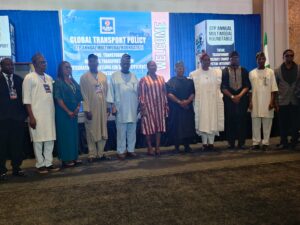
Speaking at the Global Transport Policy (GTP) 2026 Annual Multimodal Roundtable held in Lagos on Wednesday, the Chairman of CILT Nigeria Council, Dr. Boboye Oyeyemi, warned that the country’s fragmented transport system is no longer sustainable in the face of growing population pressures and rising logistics demands.
The conference, themed “Transforming System: Integrating Solutions for Safety, Efficiency and Sustainability,” brought together key stakeholders from across the transport and logistics value chain to chart a new course for the sector.
According to Oyeyemi, global transportation trends have shifted beyond traditional infrastructure development to embrace predictive safety systems, intelligent logistics, green transportation, innovative financing models, and future mobility solutions.
“Nigeria, with over 240 million people, a vast landmass of 923,000 square kilometres, 830 kilometres of coastline, and an extensive but poorly coordinated transport network, requires urgent modernisation and integration,” he said.
He noted that despite having more than 204,000 kilometres of roads and over 14 million registered drivers, the country’s transport ecosystem remains plagued by inefficiencies arising from poor interconnectivity among road, rail, inland waterways, and pipeline networks.
According to him, the absence of a truly integrated multimodal transport system continues to undermine mobility, increase logistics costs, and constrain economic productivity.
Oyeyemi lamented that while successive governments have invested heavily in roads, bridges, rail infrastructure, and seaports, weak institutional frameworks, poor maintenance culture, inadequate data management, and accountability gaps have limited the impact of these investments.
He further identified truck overloading, the absence of functional weighbridges, and weak enforcement mechanisms as major contributors to the rapid deterioration of transport infrastructure across the country.
“We have invested substantially in transport assets, but infrastructure alone is not enough. What Nigeria needs now is integration, intelligence, and efficient systems management to maximise returns on investment and improve mobility,” he stressed.
The former Corps Marshal of the Federal Road Safety Corps (FRSC) warned that without policy continuity, data-driven planning, and coordinated governance structures, Nigeria’s transport sector would continue to struggle, resulting in higher costs of doing business and slower economic growth.
Earlier, Chairman of the Global Transport Policy (GTP), Dr Segun Musa, painted a grim picture of the economic consequences of transport inefficiencies, revealing that Nigeria loses an estimated #3.2 trillion annually due to logistics and transportation bottlenecks.
He disclosed that logistics costs currently account for more than 42 percent of Nigeria’s Gross Domestic Product (GDP), a figure he described as unsustainable for a country seeking economic transformation.
Musa also highlighted persistent challenges including excessive dependence on road transportation, underutilisation of rail systems, high accident rates, low levels of digitalisation, and critical skills shortages within the transport workforce.
According to him, only about 18 per cent of the transport workforce is digitally enabled, underscoring the need for massive investments in capacity building and technology adoption.
He called for stronger public-private partnerships, accelerated deployment of smart mobility solutions, and the development of an integrated multimodal transport network capable of driving sustainable growth.
“The task before us is clear. We must move beyond discussions and deliver practical, actionable solutions that will create a safer, more efficient, and environmentally sustainable transport future for Nigeria,” Musa said.