

Joyce Mmereole Okoli
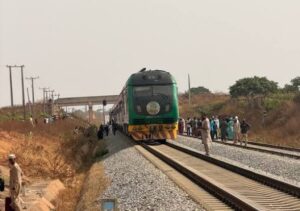
Rail freight operations into the Apapa Port corridor have received a significant boost following the clearing of rail tracks within the operational area of Apapa Bulk Terminal (ABT), following a report by Harboursandport.com highlighting how container-laden trains experienced delays while accessing the Apapa Port corridor. a development expected to enhance cargo evacuation and improve logistics efficiency at Nigeria’s busiest seaport.
A recent visit to the terminal showed that the rail corridor, previously affected by truck movements within the facility, is now free of obstructions, allowing trains to move seamlessly through the terminal’s operational zone.
From the entrance to the exit of the facility, no trucks were seen occupying the rail alignment, paving the way for smoother rail operations and supporting ongoing efforts to deepen multimodal transportation within the Lagos port ecosystem.
Speaking on the development, the Managing Director of Apapa Bulk Terminal Limited, Festus Omotoyibo, directed enquiries to the Terminal Manager, Remi Akindele, who explained that the terminal has always maintained operational procedures designed to ensure unhindered train movements.
According to Akindele, designated truck holding areas have consistently been maintained away from the rail corridor, with any temporary presence of trucks near the tracks resulting from normal vehicle movements within the terminal.
“There were no trucks permanently parked on the rail track. What may have been observed were trucks in transit. Naturally, vehicles moving in and out of the terminal have to cross the rail line at certain points,” he said.
Akindele noted that the terminal works closely with the Nigerian Railway Corporation (NRC) to coordinate train movements and prevent disruptions.
“We always ask the NRC to notify us ahead of train arrivals. Once we receive that information, trucks in transit are held back to ensure trains can pass freely. That has always been our procedure. Perhaps we have improved on the process, but essentially nothing has changed,” he stated.
Also commenting on rail operations within the port, the Port Manager of Lagos Port Complex, Adebowale Lawal, emphasized that safety remains a cardinal requirement for all terminal operators.
He explained that established protocols are in place to regulate train traffic and prevent congestion along the rail corridor.
“Safety is non-negotiable for us. Every terminal operator is required to comply with the safety provisions contained in its concession agreement, and we conduct regular inspections to ensure adherence,” Lawal said.
He further explained that train movements are carefully managed to ensure operational efficiency, noting that where two trains are scheduled to access the port corridor, one is allowed entry while the other waits until the first concludes its operation and exits.
“We carry out constant monitoring to ensure all operators comply with the agreed standards. The objective is to guarantee seamless operations while maintaining the highest safety standards within the port environment,” he added.