

Joyce Mmereole Okoli
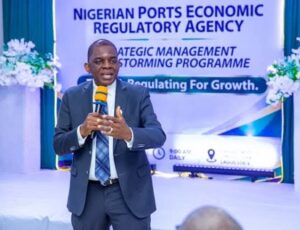
The Director-General and Chief Executive Officer of the Nigerian Ports Economic Regulatory Agency (NPERA), Dr. Pius Akutah, has unveiled an ambitious strategic blueprint for building a financially sustainable, technologically driven, transparent and globally competitive port economic regulator, declaring that the successful transformation of Nigeria’s port sector begins with strong institutional leadership and a clear vision for the future.
Speaking at the Agency’s Strategic Management Brainstorming Programme, themed “Regulating for Growth,” in Lagos, Akutah challenged management staff to embrace the responsibilities of the new regulatory era, stressing that the transition from the Nigerian Shippers’ Council (NSC) to NPERA must go beyond a change of institutional identity to deliver a fundamental transformation of Nigeria’s port regulatory landscape.
“The law has come to pass, it has been signed. We have entered NPERA. Effective regulation needs us to do a lot. The transition has started,” he declared.
The programme brought together management staff to critically examine the provisions of the new NPERA Act, identify institutional priorities, assess existing structures and develop a strategic roadmap for positioning the Agency as a modern and effective economic regulator.
Akutah described the brainstorming session as a defining moment in the Agency’s transition, providing an opportunity to rethink its institutional architecture, strengthen internal capacity and establish the governance structures required to deliver on its expanded statutory responsibilities.
According to him, the exercise would address critical issues surrounding the legal and institutional frameworks, organisational structure, the relationship between the Board, Management and Staff, as well as the engagement of industry stakeholders in the emerging regulatory environment.
“We are looking at the legal framework, the institutional framework, and even the organogram. The relationship between the Board, Management and Staff, and also what we need to do to bring stakeholders to the realisation that we have come to a new era,” he explained.
He noted that the discussions would also help define the respective roles, responsibilities and expectations of stakeholders under the new regulatory regime, describing the programme as an important starting point for the work of the Transition Implementation Committee.
A major highlight of Akutah’s address was his emphasis on financial sustainability as a critical pillar of the new Agency’s success.
He charged management staff to begin thinking beyond routine administrative responsibilities and develop innovative approaches to revenue generation, operational efficiency, value creation and institutional sustainability.

According to him, NPERA must be deliberately structured to operate as a financially viable, technologically enabled and performance-driven institution capable of delivering effective regulation without compromising transparency and accountability.
“Without financial sustainability, the Agency cannot drive reforms, deploy technology or sustain effective regulation of the nation’s port sector,” he warned.
The NPERA boss stressed that the Agency’s ability to discharge its statutory responsibilities would depend significantly on its financial strength, operational effectiveness and capacity to deploy modern regulatory tools.
He therefore urged participants to develop practical strategies that would guarantee institutional efficiency, strengthen service delivery and position NPERA to respond effectively to the changing demands of the maritime industry.
Akutah emphasised that the emergence of NPERA should not be treated as a mere rebranding exercise but as a fundamental shift in institutional mandate, regulatory authority and operational expectations.
He explained that the new Agency must build on the institutional knowledge, experience and achievements of the former Nigerian Shippers’ Council while developing the structures and capabilities necessary to fulfil its expanded responsibilities.
He also underscored the importance of succession planning, noting that sustainable institutions must be designed to outlive individual leadership tenures.
Management staff, he maintained, have a critical responsibility to establish systems, processes and institutional values that will guarantee continuity, stability and long-term effectiveness.
Addressing longstanding concerns over the high cost of doing business at Nigerian ports, Akutah said the establishment of NPERA was a strategic response to persistent industry complaints about service failures, operational inefficiencies and the country’s competitiveness in the global maritime market.
He maintained that the new legislation had equipped the Agency with the necessary legal authority to confront these challenges and promote a more efficient, transparent and competitive port environment.
While assuring stakeholders that significant internal activities were already underway to actualise the new regulatory framework, he emphasised that the implementation process would be inclusive, with relevant industry stakeholders carried along.
The DG/CEO also acknowledged the role of the Minister of Marine and Blue Economy, Dr. Adegboyega Oyetola, CON, in unveiling the law and logo of the new Agency.
He disclosed that both the Federal Ministry of Marine and Blue Economy and NPERA had established Transition Implementation Committees to coordinate activities and ensure a seamless transition into the new regulatory dispensation.
Reiterating the vision for the emerging institution, Akutah said NPERA must distinguish itself through measurable performance, institutional credibility and the effective discharge of its statutory mandate.
He challenged management staff to see the transition as a collective responsibility and an opportunity to build an institution capable of promoting efficiency, encouraging healthy competition, improving port services and creating an enabling environment for sustainable investment and growth.
The Strategic Management Brainstorming Programme represents another significant step in ongoing efforts to reposition NPERA as a modern, financially viable, technologically driven and credible port economic regulator.

Ultimately, the success of the new Agency will be measured not merely by the establishment of a new institution, but by its ability to deliver tangible improvements in port operations, reduce the cost of doing business, strengthen stakeholder confidence and enhance the competitiveness of Nigeria’s maritime industry.
