

Joyce Mmereole Okoli
The Lagos State Waterways Authority (LASWA) has called for the development of a homegrown multimodal transportation system tailored to Nigeria’s unique circumstances, warning against the wholesale adoption of foreign transport models that may not adequately address the country’s needs.
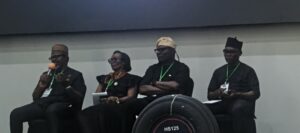
The Assistant Chief Occupational Safety Officer in the Health, Safety, Security and Environment (HSSE) Unit of LASWA, Mr Shittu Oladimeji, made the call during a panel session at the second edition of the JustNet Transport Summit held on Friday, October 23, 2026, in Lagos.
The summit brought together stakeholders in the transportation, energy and trade sectors to discuss strategies for improving Nigeria’s transport infrastructure, with particular emphasis on rail-led multimodal integration and the efficient movement of passengers and freight.
Oladimeji, who represented the Special Adviser to the Lagos State Governor on Blue Economy, Mr Oludamilola Emmanuel, said an effective multimodal transportation system must be built around proper infrastructure planning, strategic location of facilities, seamless connectivity and adequate safety measures.
He stressed that the construction of rail lines, seaports and road terminals would not automatically translate into efficient transportation unless such facilities were strategically located to serve their intended purposes.
According to him, the success of multimodal transportation depends largely on how well different transport infrastructure and services are connected to facilitate the seamless movement of goods and passengers from their points of origin to their final destinations.
He explained that freight often originates from locations accessible by road before being transferred to rail or other transportation modes, making it necessary for infrastructure planners to consider the relationship between road networks, railway lines, ports and other logistics facilities.
Oladimeji noted that poor planning and the inappropriate location of transport infrastructure could undermine the benefits of multimodal integration, regardless of the level of investment committed to such projects.
He therefore urged policymakers and infrastructure developers to adopt a coordinated approach that ensures different transportation systems complement one another rather than operate in isolation.
Highlighting Lagos State’s efforts to promote integrated transportation, he said the state government was developing a system that connects road, rail and waterways, providing commuters with multiple options for completing their journeys.
He identified the Cowry Card payment system as one of the initiatives supporting this integration, explaining that commuters could use a single payment platform to access services such as Bus Rapid Transit (BRT), rail and water transportation.
According to him, the system demonstrates how different transport modes can be connected to improve convenience, reduce travel difficulties and provide commuters with alternatives to road transportation.
To illustrate the benefits of multimodal integration, Oladimeji cited a hypothetical journey from Ikorodu to Okoko, explaining that a commuter could travel by road to a jetty, take a boat to Marina, connect to the train to Mile 2 and complete the remaining part of the journey by road.
He said such an arrangement would allow commuters to combine available transport options according to their destinations while reducing dependence on road travel alone.
Oladimeji added that integrating road, rail and water transportation could help ease the pressure on Lagos roads by distributing passenger traffic across different modes and providing alternatives when particular routes experience congestion.
He maintained that Nigeria did not necessarily need to replicate transportation systems developed in other countries, arguing that local solutions would be more effective if designed around the country’s geographical realities, economic activities, infrastructure limitations and commuting patterns.
Rather than importing foreign models without adequate consideration of local conditions, he urged transport authorities to develop systems that reflect the specific needs of Nigerian cities and communities.
He also called on the Federal Government and the Lagos State Government to ensure that transportation infrastructure projects were fit for purpose, strategically positioned and adequately maintained to deliver their intended benefits.
On safety, the LASWA official described public confidence as a critical factor in determining the success and acceptance of any transportation system.
He explained that commuters were more likely to embrace a particular mode of transportation when they were confident that it was safe, reliable and capable of taking them to their destinations without unnecessary risks.
Using Lagos waterways as an example, Oladimeji said growing confidence in the safety of water transportation had encouraged more people to consider boats as an alternative to road travel.
He emphasised that safety considerations must be incorporated into the planning, construction and operation of transportation infrastructure rather than treated as an afterthought.
“Then you also need to consider the safety of whatever you are going to build, because what will drive people to a particular mode of transport is safety. When people have confidence in a particular mode of transport, they tend to use it more,” he said.
Referring to water transportation in Lagos, he added that public perception of safety was helping to attract more commuters to the waterways.
“Just like in Lagos State, for example, and if you look at the Lagos Waterway, people are now coming to Lagos Waterway because of the perceived safety that exists in that waterway,” Oladimeji said.
He reiterated that an efficient multimodal transport system must combine appropriate infrastructure, effective interconnectivity, proper maintenance and strong safety standards to deliver sustainable benefits.
Oladimeji’s position underscores the need for Nigeria to adopt a transport development strategy that integrates its various transportation modes while prioritising local realities, operational efficiency and passenger confidence.
For Lagos, where road congestion remains a major transportation challenge, the continued integration of waterways, rail and road services presents an opportunity to expand commuter choices, improve mobility and support the movement of goods and people across the state.