

Joyce Mmereole Okoli
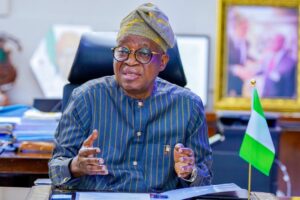
Nigeria’s maritime sector has entered a historic phase of renewal as a result of bold, far-reaching reforms championed by the Minister of Marine and Blue Economy, Dr. Adegboyega Oyetola, CON.
According to the Minister’s Special Adviser, Dr. Bolaji Akinola, the once-stagnant marine and blue economy has been “decisively unlocked” under Oyetola’s leadership, with several entrenched obstacles, long considered permanent finally broken in 2025.
Akinola said the Minister’s strategic interventions since his assumption of office in August 2023, and especially in 2025, dismantled structural constraints that had crippled the sector for decades. These reforms, he noted, restored stakeholder confidence, enhanced performance, and firmly repositioned the maritime and blue economy as a key driver of Nigeria’s economic diversification agenda.
Top among the breakthroughs, Oyetola’s spokesman said, is the long-awaited resolution of the Apapa gridlock—a crisis that crippled the Lagos port corridor for over 20 years.
By early 2024, through disciplined policy coordination and infrastructure optimisation, the Ministry delivered lasting relief to Apapa. The feat slashed cargo dwell time, reduced logistics costs, boosted port efficiency, and reopened the Lagos ports as viable gateways for national and regional commerce.
Another decades-old setback also ended in 2025 when Nigeria reclaimed its seat on the International Maritime Organisation (IMO) Council after a 14-year absence. Akinola described the feat as a powerful restoration of Nigeria’s global maritime influence—achieved through Oyetola’s focused leadership and diplomatic engagement.
He said the victory strengthens Nigeria’s authority in shaping global maritime regulations and reinforces its leadership across Africa’s maritime landscape.
Akinola also announced that in 2025, the Minister secured long-overdue approval for Nigeria’s first full-scale port upgrade and modernisation in more than five decades.
He described the approval as a landmark development that will bring Nigerian ports in line with global standards, attract bigger vessels, improve competitiveness, and position the country as a strategic maritime and logistics hub for West and Central Africa.
In another major milestone, the Ministry issued compliance certificates for the Bakassi Deep Sea Port and the Ondo Deep Sea Port—granting both states the regulatory clearance needed for accelerated investment and commencement of port development.
Akinola said the approvals represent a crucial breakthrough that will expand Nigeria’s port capacity and deepen regional trade connectivity.
The Special Adviser further highlighted the establishment of the Regional Maritime Development Bank (RMDB) in 2025, ending a 16-year deadlock that denied the maritime sector access to long-term, affordable financing.
With the bank now operational, he said, the shipping, port development and maritime services ecosystem can expect a new wave of investment support essential for sustained growth.
Equally transformative, Akinola said, was the Minister’s approval for the Nigerian Maritime Administration and Safety Agency (NIMASA) to commence disbursement of the Cabotage Vessel Financing Fund (CVFF) in 2025.
Dormant for over 20 years, the activation of the CVFF marks a turning point for indigenous shipowners—enabling fleet expansion, acquisition of modern vessels, and increased competitiveness in coastal and international trade.
Another historic achievement in 2025 was the approval of Nigeria’s first-ever National Policy on Marine and Blue Economy by the Federal Executive Council.
Akinola described it as a game-changing framework that harmonises shipping, ports, fisheries, aquaculture, marine tourism, offshore energy, seabed resources, and environmental sustainability under one cohesive national strategy.
The policy, he said, brings clarity to investors, enhances inter-agency coordination, protects marine ecosystems, and sets a long-term roadmap for sustainable value creation and job generation.
Akinola also underscored major improvements in maritime security, noting that enhanced coordination of assets under the Deep Blue Project ensured zero piracy incidents in Nigerian waters throughout 2025, further reinforcing the country’s credibility as a safe and reliable maritime domain.
He added that Nigeria recorded a 300,000-metric-tonne increase in fish production in 2025, the first such growth in more than ten years.
This, he said, reflects the Minister’s firm commitment to reducing dependence on fish importation and stimulating job creation across the fisheries value chain.
According to Akinola, the cumulative effect of these achievements is the establishment of a strong, sustainable foundation for the marine and blue economy.
He described 2025 as a “defining year” marked by bold reforms and concrete results.
Looking ahead, the Special Adviser reaffirmed the Minister’s unwavering commitment to supporting indigenous shipowners, boosting fish production, and pursuing policies that foster competitiveness and inclusive growth.
“With the jinxes that held the sector down for decades now broken, the marine and blue economy is set for accelerated expansion,” Akinola said. “The Minister remains resolute in building on these gains to deliver even greater outcomes in the years ahead.”