

Joyce Mmereole Okoli
Dr. Emeka Akabogu, SAN, Senior Partner at Akabogu & Associates, has taken participants at the 6th Maritime Writes Project (MWP) Creative Writing Bootcamp through eight landmark Nigerian maritime cases, urging writers to deepen their understanding of the legal foundations of the industry to produce credible and authoritative maritime literature.
Akabogu made the presentation during Day Three of the bootcamp in a session titled “Real Cases Every Maritime Writer Should Know,” where he simplified complex judicial decisions covering shipping, ports, maritime jurisdiction, cargo claims and environmental protection.
He said understanding landmark court decisions would enable maritime writers to properly interpret events and avoid inaccuracies when reporting or documenting developments in the sector.
According to him, “A maritime writer cannot afford to write about the industry without understanding some of the legal principles that govern it. These cases provide the foundation for understanding how the courts have interpreted critical issues in Nigeria’s maritime space.”
He explained that the objective was not to turn the participants into lawyers, but to equip them with sufficient legal knowledge to enrich their writing.
“You don’t have to be a lawyer to understand these cases. What is important is that you know the principles established by the courts and how they affect the maritime industry. That knowledge will make your books, articles and stories more accurate and authoritative,” he said.
Among the cases examined was Owners of the M.V. Arabella v. Nigeria Agricultural Insurance Corporation, which addressed the Federal High Court’s exclusive admiralty jurisdiction and the strict requirements for serving court processes outside Nigeria.
He also examined The Owners of the M.V. Lupex v. Nigerian Overseas Chartering and Shipping Ltd, where the Supreme Court upheld the binding nature of arbitration agreements.
In Basinco Motors Ltd v. Woermann-Line & Anor, Akabogu highlighted the court’s clarification that being named as a “notify party” on a bill of lading does not, by itself, confer the right to sue. A similar principle was also examined in Pacers Multi-Dynamics Ltd v. The M.V. Dancing Sister & Anor.
Other landmark decisions discussed included Centre for Oil Pollution Watch v. NNPC, which reinforced access to the courts in matters relating to environmental protection, and the Resource Control case, which clarified the constitutional status of Nigeria’s territorial waters, exclusive economic zone and continental shelf.
Akabogu also highlighted SIFAX (Nig) Ltd v. Migfo (Nig) Ltd, stressing that the mere fact that a dispute is connected to a port does not automatically make it an admiralty matter.
He further examined Alraine Shipping Agencies (Nig) Ltd & Ors v. Nigerian Shippers’ Council & Anor, which provides important guidance on the regulatory framework governing port charges.
The legal session, Akabogu said, was designed to give writers practical tools for interpreting maritime events and transforming complex industry issues into well-researched and credible literary works.
“The maritime industry is governed by laws, regulations and judicial decisions. If writers understand these foundations, they can tell better stories and produce literature that will stand the test of time,” he added.
Also on Day Three, Chief Lecturer and Member of the Academic Board, Moshood Abiola Polytechnic, Dr. Lucky Aikabeli, took participants through the publishing process in a session titled “The A-Z of Publishing: From Manuscript to Market.”
Aikabeli examined the journey from developing a manuscript to producing, publishing and positioning a book for the market. He drew attention to the standards and decisions that determine whether a publication is professionally acceptable and commercially viable.
He urged the writers to approach publishing as a structured process rather than simply the final stage of writing.
“Writing the manuscript is only one part of the journey. A good writer must also understand editing, production, presentation, publishing and how to position the finished work for the right audience,” Aikabeli said.
His presentation provided participants with practical knowledge on how to transform creative ideas into professionally produced books capable of reaching wider audiences.
Also contributing to the creative dimension of the programme was renowned coffee artist, Mr. Ekene Ngige, who challenged participants to look beyond words and appreciate the growing importance of visual storytelling, particularly in children’s literature.
Ngige demonstrated how artistic presentation, book-cover design and illustrations can strengthen a story’s appeal while helping to communicate its message to young readers.
“A book begins to tell its story even before the reader turns the first page. The cover, illustrations and overall visual presentation can determine whether a child is attracted to the book,” Ngige said.
He stressed that carefully selected visuals could make children’s books more engaging, attractive and marketable.
The three sessions broadened the participants’ understanding of maritime writing, taking them beyond storytelling to the legal, publishing and visual elements required to transform an idea into a compelling finished book.
The Day Three programme also featured industry-specific sessions by the Executive Director, Operations and Technical, Tantita Security Services Nigeria Limited, Capt. Warredi Enisuoh; Director, Reforms Coordination and Blue Economy and former Nigerian Registrar of Ships, Mrs. Nneka Obianyor; Master Mariner and President of MAPROD, Capt. Oluwasegun Akanbi; Harbour Master, Lagos Pilotage District, Nigerian Ports Authority, Capt. Marvin Omovbude; among other industry experts.
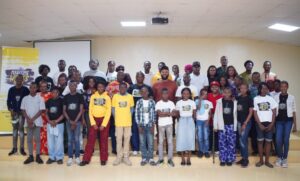
The 6th edition of the Maritime Writes Project Creative Writing Bootcamp is designed to equip participants with the knowledge, skills and industry perspectives required to produce high-quality literature on Nigeria’s maritime and blue economy sectors.