

Joyce Mmereole Okoli
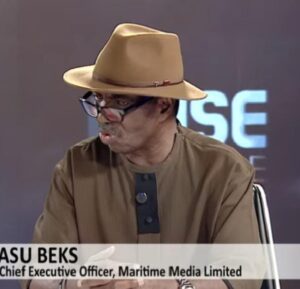
Veteran maritime journalist and Chief Executive Officer of Maritime Media Limited, Elder Asu Beks, has urged President Bola Ahmed Tinubu to immediately concession the Nigerian Maritime Administration and Safety Agency’s abandoned ₦50 billion floating dockyard, describing the dormant asset as a “national embarrassment” after more than ten years of neglect.
Speaking during a live interview on Arise TV on Tuesday, Beks said the multi-billion-naira dock—originally earmarked for Okerenkoko to support training at the Nigerian Maritime University, has been shuffled from one facility to another without ever becoming operational.
Since its acquisition in 2016, the floating dock has moved between the Naval Dockyard Limited, Continental Shipyard Limited, and most recently Snake Island Integrated Free Zone, yet remains idle while the government continues to shoulder maintenance costs.
“Why should Nigeria allow an asset worth about ₦50 billion to waste away for over 10 years?” Beks queried, warning that the continuing dormancy of the facility reflects poorly on public asset management.
He urged the Federal Government to concession the dockyard to a competent indigenous operator capable of putting it to productive use, recommending Tantita Security Services Limited based on its operational reach and established performance in pipeline and maritime security.
“With the technical capacity and operational network of companies like Tantita, this abandoned asset can be transformed into a profitable national facility,” he said.
Beks reserved strong criticism for past leadership in the maritime sector, faulting the eight-year tenure of former Minister of Transportation Rotimi Amaechi and former NIMASA Director-Generals Dakuku Peterside and Bashir Jamoh for failing to resolve the lingering impasse.
He called on current NIMASA Director-General Dr. Dayo Mobereola to “change the narrative” by ensuring the floating dockyard is finally put to work, noting that its activation would boost ship-repair capability, expand maritime training opportunities, and reduce Nigeria’s dependence on foreign dry-docking facilities.
Beks stressed that issues such as the utilisation of the floating dockyard and strong economic regulation in the shipping sector remain far more consequential than symbolic sector achievements.
According to him, “Nigeria must prioritise the productive use of strategic maritime assets if it truly wants to unlock economic value and reposition the maritime industry.”