

Joyce Mmereole Okoli
The Minister of Marine and Blue Economy, Dr. Adegboyega Oyetola, has reaffirmed that the long-awaited disbursement of the Cabotage Vessel Financing Fund (CVFF) will commence soon, describing it as a major catalyst for job creation and the growth of Nigeria’s indigenous shipping capacity.
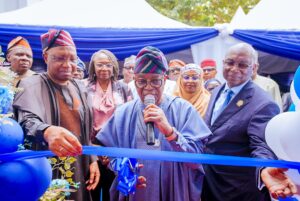
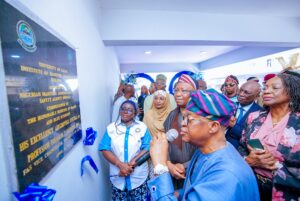
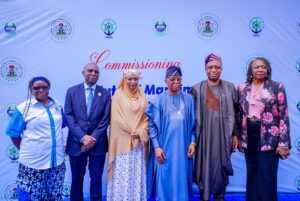
Dr. Oyetola made this known on Thursday, 16 April 2026, while commissioning the NIMASA-funded Institute of Maritime Studies (IMS) Multipurpose Building at the University of Lagos.
“The disbursement of the Cabotage Vessel Financing Fund is no longer a distant goal but an imminent reality,” the Minister stated.
“This intervention will empower indigenous shipowners, expand our national fleet, and create not less than 30,000 jobs across the maritime value chain.”
He stressed that the CVFF remains a critical tool for reducing Nigeria’s dependence on foreign vessels and retaining more value within the domestic economy.
“For too long, Nigerian operators have faced capital constraints that limit their participation in coastal and inland shipping. The CVFF is designed to change that narrative by providing the financial backbone required for growth and competitiveness,” Oyetola added.
The Minister also underscored the importance of aligning vessel financing with human capacity development, noting that the Federal Government has already made significant investments in maritime training.
“We are not only preparing assets; we are preparing people. Through the Nigerian Seafarers Development Programme, thousands of Nigerians have been trained to take advantage of the opportunities that will come with increased vessel ownership,” he said.
According to him, 2,459 Nigerians have been trained under the programme, with 1,088 already earning their Certificates of Competency.
Dr. Oyetola further disclosed that ongoing port modernisation projects are expected to generate an additional 20,000 jobs while improving operational efficiency.
“Modern ports are essential to a modern maritime economy. Our reforms will reduce turnaround time, improve trade facilitation, and position Nigeria as a leading maritime hub in West and Central Africa,” he said.
Earlier, the Director-General of NIMASA, Dr. Dayo Mobereola, highlighted the strategic importance of the CVFF to the agency’s long-term vision.
“The CVFF is a critical enabler for indigenous participation in the maritime sector. Its disbursement will not only support vessel acquisition but also stimulate employment and ancillary services within the industry,” Mobereola said.
“We are deliberately investing in human capital and institutional partnerships to ensure that Nigerians are fully prepared to take advantage of the opportunities that will arise.”
He noted that NIMASA is collaborating with eight Nigerian universities and international institutions, including the World Maritime University, to strengthen maritime education and workforce development.
In her remarks, the Vice-Chancellor of the University of Lagos, Professor Folasade Ogunsola, said the new facility would play a key role in preparing professionals for the evolving demands of the maritime sector.
“This building represents more than infrastructure; it is an investment in knowledge, innovation, and the future of Nigeria’s maritime industry,” she said.
“We are committed to producing graduates who are not only academically sound but industry-ready.”
Also speaking, the Pro-Chancellor and Chairman of Council, Chief Wole Olanipekun, SAN, commended the Federal Government for prioritising the maritime sector.
“The anticipated disbursement of the CVFF is a welcome development that will open new frontiers for Nigerian participation in shipping,” he said.
“The University of Lagos stands ready to support this vision through quality training and research.”